Sacred Valley Architecture Guide
Learn how to read the Sacred Valley’s architecture across Pisaq, Ollantaytambo, Chinchero, and Moray, with practical ticket advice and a two-day viewing strategy.
 Visit Sacred Valley
August 26, 2026
Visit Sacred Valley
August 26, 2026

The Sacred Valley rewards travelers who slow down and look closely. Walls, terraces, paths, openings, and changes in stone treatment become more revealing when viewed as parts of a larger design. A focused route can connect four archaeological parks included in Circuit III of the Cusco Tourist Ticket: Pisaq, Ollantaytambo, Chinchero, and Moray.
- Use Pisaq, Ollantaytambo, Chinchero, and Moray as the framework for an architecture-focused Sacred Valley itinerary.
- Allow two days if using the foreign-visitor Circuit III ticket, which COSITUC currently lists as valid for two days.
- Separate admission from trip costs. The visitor ticket does not include a guide or transportation.
- Buy the ticket in person, either at the COSITUC counter in Cusco or at an eligible included attraction.
- Check current prices, validity, site schedules, road conditions, and temporary restrictions shortly before traveling.
Nearby Cusco provides useful regional context. UNESCO recognizes the exceptional aesthetic and structural qualities of Inca stone construction there, along with the continuing relationship between Inca and colonial architecture in the city. That context encourages careful comparison, but individual Sacred Valley structures still need to be read on their own terms rather than assigned a date or function by appearance alone.

From Urubamba & Ollantaytambo: Sacred Valley Day tour with Lunch
Explore the best and most unique sites in the Sacred Valley on a private tour. Visit the impressive ruins of Ollantaytambo, an ancient Inca fortress...
What an architecture-focused visit should reveal
Architecture is more than a collection of impressive walls. It organizes movement, controls access, frames views, manages changes in level, and defines the relationship between enclosed and open space. The best way to explore is to ask what each visible element does before deciding what it means.
Begin with the broad composition. Notice how paths approach a structure, where the ground rises or falls, and whether walls direct you toward a threshold or open area. Then move closer to inspect edges, joints, corners, surfaces, and changes in material. This wide-to-close sequence keeps one striking detail from overwhelming the larger plan.
Keep observation separate from interpretation. You can confidently record that two sections use different stone sizes or that one wall changes direction. Claims about construction phases, ceremonial meaning, or precise functions require stronger site-specific interpretation. A knowledgeable guide can help distinguish an observation from a historical conclusion.
| Element | What to examine | Useful question |
|---|---|---|
| Wall line | Direction, thickness, corners, and changes in level | Is the wall enclosing, supporting, dividing, or guiding movement? |
| Stone face | Surface treatment, size, and visible variation | Does the treatment change between connected sections? |
| Joint | Width, regularity, and treatment around corners | Does the joint pattern continue across the whole wall? |
| Opening | Position, shape, and relationship to the adjoining space | What route or view does the opening control? |
| Transition | Where one material, level, or alignment meets another | Does this junction look continuous or added later? |
| Landscape relationship | Slope, open ground, and surrounding sightlines | How does the built form respond to its setting? |
Build the route around the four Circuit III parks
Circuit III offers a ready-made four-site framework. Its included archaeological parks are Pisaq, Ollantaytambo, Chinchero, and Moray. The ticket groups them for admission purposes, but it does not provide a complete architectural narrative. Give each stop a distinct viewing question so the parks do not blur into one long sequence of stone and photographs.
| Park | Primary viewing exercise | Record before leaving |
|---|---|---|
| Pisaq | Follow the sequence of spaces and changes in elevation | A simple sketch of the route and its major turns |
| Ollantaytambo | Compare the archaeological park with the surrounding townscape | Examples of formal stone treatment and everyday street fabric |
| Chinchero | Study junctions between visibly different materials and sections | Close views of transitions, corners, and altered alignments |
| Moray | Read the circular terrace geometry at broad and close scales | A wide composition and one repeated detail |
Do not treat this table as a claim that every visible feature belongs to one period or served one purpose. It is a field method. The aim is to leave each park with organized observations that can later be compared, rather than a camera roll filled with isolated walls.
Read stonework through relationships, not single details
Inca stone construction is central to the architectural identity of the Cusco region. UNESCO highlights both its structural and aesthetic qualities in historic Cusco. For a visitor, the most useful response is patient comparison: inspect how stones meet, how corners are resolved, and how the wall behaves as a complete structural and visual unit.

Avoid judging workmanship only by stone size. Small stones can belong to a carefully organized wall, while a large block says little by itself about the date or importance of a structure. Look at the consistency of an entire section, including joints, courses, corners, openings, and the way it meets the ground.
Changes are often the most informative places to look. Pause where a wall shifts alignment, a surface treatment changes, or one material meets another. Photograph the complete junction before taking a close-up. Without the wider frame, a detailed image can lose the evidence that made it useful.
- Stand back and identify the wall’s overall direction and purpose.
- Move closer to compare several joints rather than one dramatic example.
- Inspect a corner or opening to see how the pattern continues.
- Find the point where the wall meets another section or the ground.
- Write down what is visible before adding an interpretation.

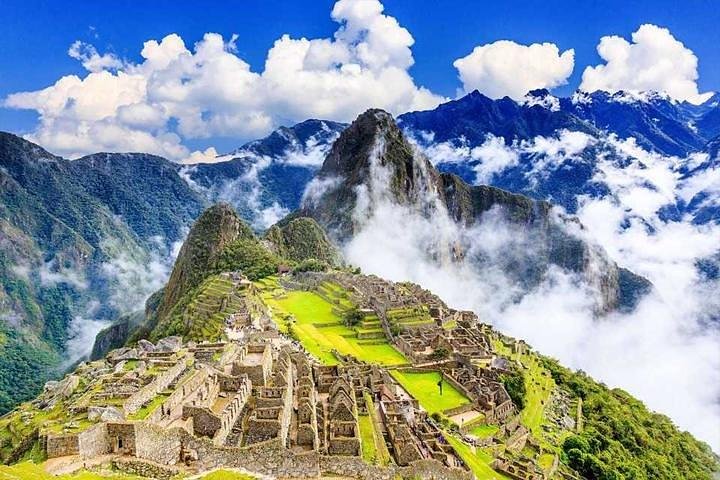
Machu Picchu Entrance Ticket Official Circuits
Discover the wonders of Machu Picchu with an official entrance ticket that allows you to explore this ancient Inca c...
Machu Picchu Entrance Ticket
This experience gives you something most travelers can’t find: peace of mind. Whether you plan ahead or need a sol...

Machu Picchu: Official Entrance Tickets
With this ticket you can visit the Inca city of Machu Picchu. The ticket allows you to visit most of the archaeologi...
Pisaq: follow the architectural sequence
At Pisaq, make movement the central theme of your visit. Instead of rushing toward a single viewpoint, track how the route unfolds. Note each turn, threshold, level change, and pause between spaces. Ask whether the built elements open the route, narrow it, redirect it, or separate one zone from another.
Use photographs in sets. Take one wide frame showing the setting, one middle-distance image of the wall or space, and one close view of a junction or surface. This three-image method preserves context and makes later comparison with the other parks much easier.
Allow the archaeological park and modern settlement to remain separate parts of your notes. For a broader day beyond architecture, the Pisac ruins and market guide explains how to combine the two subjects without reducing either to a hurried stop.
Ollantaytambo: compare archaeological and lived spaces
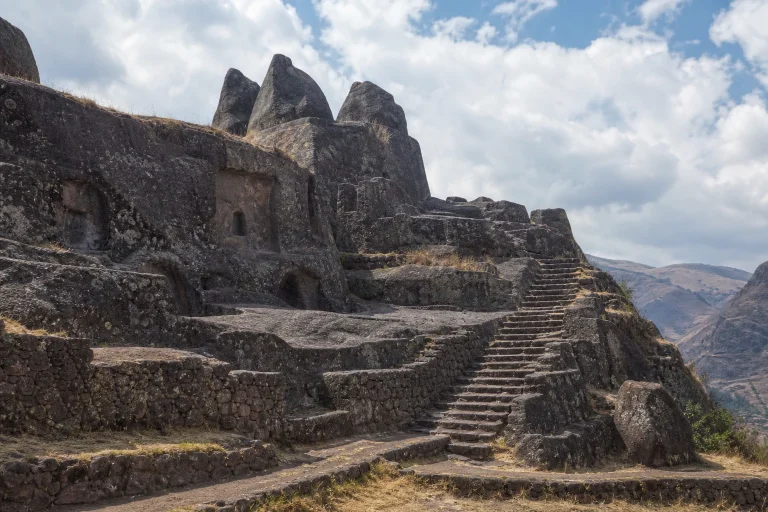
Ollantaytambo invites two scales of observation: the archaeological park and the surrounding town. Keep separate notes for each. Inside the park, follow the arrangement of walls, routes, and open areas. In the town, watch how stone, streets, entrances, drainage lines, repairs, and newer surfaces meet within spaces that remain in daily use.
The contrast is valuable, but do not assume that every old-looking wall is the same age or that every visible change marks a particular historical event. Concentrate on what can be described: material, alignment, joint pattern, corner treatment, and the relationship between a building edge and the street.
Our Ollantaytambo stone streets guide provides a closer look at the experience of moving through the town. Read it alongside the archaeological visit if you want to understand how monumental architecture and everyday circulation occupy the same destination.
Chinchero: pay attention to layers and transitions
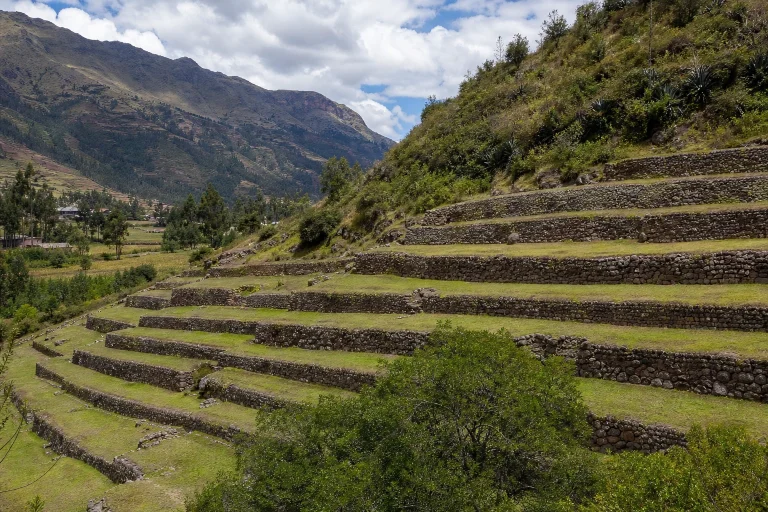
Chinchero is a good place to practice disciplined visual comparison. Look for changes in stone size, wall direction, surface finish, and building material. When two sections meet, photograph the full junction. That transition usually offers more information than a close-up of the most polished or dramatic stone nearby.

Regional history makes the relationship between Inca and colonial architecture an important subject, especially in Cusco. At Chinchero, however, avoid transferring a citywide conclusion to an individual wall without interpretation from a qualified source. Describe the visible relationship first, then ask a guide about chronology and reuse.
Built heritage is only one part of Chinchero’s identity. The Chinchero textiles and market guide adds cultural context through the town’s weaving traditions, making it a useful companion when planning more than an archaeological stop.
Moray: study geometry before assigning meaning
At Moray, begin with the broad geometry of the circular terraces. Trace the repeated lines with your eye and notice where the pattern changes, connects, or responds to the ground. Then choose one section for closer inspection. The shift between the overall form and its component parts is the main architectural exercise.
Be cautious with definitive explanations of purpose. The Circuit III information confirms Moray’s inclusion as an archaeological park, but admission material is not a substitute for detailed interpretation. A guide can explain competing ideas and the evidence behind them without turning a striking form into a simple label.
Our Moray circular terraces guide gives this single site more space than a four-stop itinerary allows. It is useful for deciding which views, details, and questions deserve attention before continuing through the valley.
Still comparing Sacred Valley Architecture And Circuit III Archaeological Itinerary?
Ask for tour ideas, hotel suggestions, or a simple trip plan that combines both.
Trip Helper
Choose the ticket that matches the rest of your Cusco trip
For foreign visitors concentrating on the four Sacred Valley parks, COSITUC currently lists the Circuit III partial ticket at S/70 with two-day validity. The comprehensive Cusco Tourist Ticket is listed at S/130, remains valid for 10 days, and includes Circuit III plus attractions on other circuits. Student and domestic tariffs follow separate conditions.
| Ticket | Currently listed foreign-visitor price | Validity | Best fit |
|---|---|---|---|
| Circuit III partial ticket | S/70 | Two days | Travelers focusing only on Pisaq, Ollantaytambo, Chinchero, and Moray |
| Comprehensive Cusco Tourist Ticket | S/130 | 10 days | Travelers who will also use other included Cusco circuits and attractions |
The comprehensive ticket costs S/60 more. It offers better value only if you will use its additional included attractions within the 10-day validity window. If your plan is limited to the four Circuit III parks, the partial ticket is the lower-cost option. Reconfirm the tariff and validity when purchasing because ticket rules can change.
The Cusco Tourist Ticket is sold in person rather than online. COSITUC lists its central counter at Av. El Sol 103, Galerías Turísticas, Cusco, with daily hours of 07:30 to 18:00. Tickets can also be purchased at included attractions, subject to listed venue exceptions, so buying at the first Circuit III park is an option.
The ticket covers admission only. It does not include transportation or guiding, so budget separately for a guide, driver, taxi, bus, rail travel, and accommodation as relevant to your itinerary. Do not treat the pass as an organized tour or transport product.
Shape two days around attention, not a race
A balanced architecture plan assigns two parks to each day. This is a suggested viewing rhythm rather than an official route. Decide the pairings after considering your accommodation, transport arrangement, current access conditions, and the hours posted for each site.

Give each day one main question. On the first, study movement through space: approaches, thresholds, turns, and level changes. On the second, concentrate on construction: joints, corners, material transitions, and the relationship between walls and ground. A narrow theme improves recall and discourages checklist tourism.
- Confirm current admission rules and site schedules shortly before departure.
- Choose two parks based on your starting point and transport plan.
- Assign one observation theme to the morning and another to the afternoon.
- Reserve time at each stop for a wide view, a route sketch, and close details.
- At the end of the day, label photographs while the sequence remains fresh.
Choose your base before fixing the order of the parks. The Sacred Valley lodging and village guide can help compare places to stay, while your transport provider can help turn that base into a realistic daily route. Avoid setting a rigid sequence until current road and operating conditions are clear.
Arrange guiding, transportation, and access separately
An architecture-focused guide is most useful when the visit goes beyond names and dates. Ask prospective guides how they explain construction sequences, later alterations, uncertain functions, and the relationship between a structure and its setting. Confirm which parks are included and how much viewing time the itinerary allows at each one.
Transportation must also be arranged separately from admission. Before departure, confirm pickup points, route, waiting arrangements, and whether your plan covers all four parks within the ticket’s validity. Public schedules and road conditions can change, so use current local information rather than building the day around an old timetable.
Travelers who require step-free access should confirm site-specific arrangements before booking. Ask about gradients, steps, surface conditions, accessible toilets, vehicle drop-off points, and how much of each park can be viewed without stairs. A specialist local provider is better placed to match the route to individual mobility needs.
Check individual site schedules, temporary closures, weather, road conditions, and local restrictions close to the travel date. These details can affect the route more than the ticket itself. One check shortly before departure is more useful than relying on a fixed itinerary prepared months in advance.

Official Machu Picchu Entrance Ticket
Secure your visit to Machu Picchu with this official entrance ticket to one of the New Seven Wonders of the World. E...

Machu Picchu Official Entry Ticket
Discover the wonder of Machu Picchu with an official entrance ticket. Choose from several official circuits, each of...

Hiking with Alpaca in Sacred Valley (3-hours Experience)
We involve local people in the activity: By doing so, we provide an opportunity for them to actively participate in...
Carry a simple field kit for closer observation
You do not need specialist equipment to study architecture. A small notebook, pencil, camera or phone, spare battery, and a way to organize photographs are enough. The notebook matters because a quick route sketch can preserve relationships that are difficult to reconstruct from individual pictures.
- A notebook and pencil for route sketches and visible details
- A phone or camera with enough storage for wide and close views
- A spare battery or power bank
- A numbered photo system that matches notebook entries
- Your physical visitor ticket and identification required for the selected tariff
- Personal supplies appropriate for the day’s current conditions
At each park, make one page of notes before leaving. Record the route, the strongest transition between spaces, one construction detail, and one question that remains unresolved. This creates a consistent record across all four sites and gives a guide something specific to discuss.
Leave with comparisons, not just photographs
The most rewarding Sacred Valley architecture itinerary is comparative. Pisaq, Ollantaytambo, Chinchero, and Moray provide four settings in which to examine space, stone, geometry, transitions, and the relationship between built form and landscape. The value comes from noticing how those relationships change rather than searching for one definitive architectural highlight.
Use the two-day Circuit III framework if these parks are your main focus, or choose the comprehensive ticket when additional Cusco attractions justify the extra cost. Arrange transportation and guiding separately, verify day-of conditions, and arrive with a short list of questions. Careful looking will do more for the experience than a packed schedule.
Frequently asked questions
Which Sacred Valley sites are included in Circuit III?
Circuit III includes the archaeological parks of Pisaq, Ollantaytambo, Chinchero, and Moray. Together, they provide a practical four-site framework for an architecture-focused trip.
How many days should I allow for a Sacred Valley architecture itinerary?
Allow two days if you want to visit all four Circuit III parks at a measured pace. The foreign-visitor partial ticket is currently listed with two-day validity, but confirm the rule when purchasing.
How much does the Sacred Valley Circuit III ticket cost?
COSITUC currently lists the foreign-visitor Circuit III ticket at S/70. The comprehensive 10-day ticket is listed at S/130, while student and domestic tariffs have separate conditions.
Can I buy the Cusco Tourist Ticket online?
No. COSITUC states that the ticket must be purchased in person. It is available from its central Cusco counter and at eligible included attractions, subject to venue exceptions.
Does the visitor ticket include a guide or transportation?
No. The Cusco Tourist Ticket covers admission only, so guiding and transportation must be arranged and paid for separately.
Is Circuit III suitable for travelers who need step-free access?
Site-specific arrangements should be confirmed before booking. Ask about gradients, steps, surfaces, toilets, vehicle drop-off points, and which areas can be viewed without using stairs.
Should I buy the partial or comprehensive Cusco Tourist Ticket?
Choose the partial ticket if you are concentrating on the four Circuit III parks. The comprehensive ticket makes better financial sense when you will also visit its other included attractions within the 10-day validity period.
What should I check shortly before visiting?
Check current prices, ticket validity, individual site schedules, temporary closures, weather, road conditions, and local restrictions. Transport and guiding should also be confirmed separately because neither is included with admission.
From Urubamba & Ollantaytambo: Sacred Valley Day tour with Lunch
Explore the best and most unique sites in the Sacred Valley on a private tour. Visit the impressive ruins of Ollantaytambo, an ancient Inca fortress...