Sacred Valley Train Stations Guide
Compare Ollantaytambo, Urubamba, Pachar, and Cusco-side departure points for Machu Picchu trains, including bimodal transfers, 2026 access changes, arrival logistics, costs, and accessibility planning.
 Visit Sacred Valley
August 20, 2026
Visit Sacred Valley
August 20, 2026

Choosing among the Sacred Valley train stations shapes the entire Machu Picchu travel day. Ollantaytambo is the principal practical rail gateway for visitors staying in the valley, while Urubamba and Pachar serve more specific itineraries. Cusco-origin tickets can include a bus-and-train combination. At the other end, the railway finishes in Machu Picchu Pueblo, where another transfer is required to reach the archaeological site.
- Start with Ollantaytambo if you are staying in the Sacred Valley and want the simplest widely available rail departure.
- Choose Urubamba only when your exact train is scheduled to serve Urubamba station.
- Treat Pachar as a service-specific boarding or transfer point rather than a substitute for Ollantaytambo.
- Read Cusco-origin itineraries carefully because the first leg can be by bus rather than train.
- Allow for the separate bus between Machu Picchu Pueblo and the archaeological park.
- For travel during the 2026 Ollantaytambo road works, check the current station access and transfer instructions shortly before departure.
For most visitors already sleeping in the Sacred Valley, Ollantaytambo is the logical first station to check. The alternatives can work well, but only when the booked service explicitly names them. A nearby town on a map does not guarantee a useful departure, so match the station name on every ticket and transfer confirmation.

Machu Picchu by Train: A Once in a Lifetime Day Trip from Cusco
See Machu Picchu in a day without the stress of organizing it yourself. From your Cusco pickup to the train, shuttle bus, entrance, and expert guided...

Machu Picchu 2Day Tour by Train from Cusco with Overnight Stay
Our tour guides at Machu Picchu are incredibly passionate about storytelling and are committed to creating unforgett...

Private Transfer from Valle Sagrado to Alejandro Velasco Astete (CUZ) Airport
Take the worry out of your departure to Alejandro Velasco Astete (CUZ) Airport and pre-book a private transfer to su...

Bus Ticket To Machu Picchu (Up & Down)
Book With Confidence Simple. Fast. Stress free. Once you book, we send your bus ticket directly to your email or Wh...
For travel in August 2026, road improvements are affecting access to Ollantaytambo station. PeruRail announced changes beginning April 13 for approximately eight months. Its notice directs station and parking traffic through Vía de Evitamiento, Rumira, San Isidro, Calicanto Bridge, and Av. Ferrocarril. It also assigns passengers on Expedition 504 and Vistadome 606 to bus transfers from Pachar during the works. Treat the eight-month period as an estimate and follow the live itinerary for your date.
Sacred Valley train stations at a glance
The right station depends on where you are staying and how the rail company has structured your service. These boarding points have different roles, and their names should never be treated as interchangeable.
| Station or departure point | Best suited to | Important detail |
|---|---|---|
| Ollantaytambo | Most travelers staying in the Sacred Valley | Principal practical gateway with listed Expedition and Vistadome departures. |
| Urubamba | Travelers staying nearby whose exact service departs there | A separate station with selected Vistadome departures. |
| Pachar | Passengers assigned there by a specific service or temporary transfer plan | A separate location that can function as a boarding or transfer point. |
| Cusco-side points | Travelers based in Cusco using an itinerary arranged by the rail operator | The trip can combine a road leg and a rail leg. |
| Machu Picchu Pueblo | Arrival for Machu Picchu rail passengers | An onward bus journey is required to reach the archaeological park. |
Before arranging a hotel pickup, private transfer, or other road connection, copy the precise station name and departure instructions from the booking. This small check prevents one of the most disruptive mistakes in the valley: arriving in Ollantaytambo when the service expects you in Pachar, or assuming a Urubamba booking departs from Ollantaytambo.
Ollantaytambo is the main Sacred Valley rail gateway
Ollantaytambo generally offers the cleanest rail plan for travelers already based in the Sacred Valley. It reduces the number of rail-side decisions compared with a Cusco-origin bimodal itinerary, although everyone still needs road transportation to the station and a separate connection after arriving in Machu Picchu Pueblo.
PeruRail lists Ollantaytambo station at Av. Ferrocarril s/n and identifies Expedition and Vistadome departures there. Its station information instructs passengers to board 30 minutes before departure. Build enough margin to reach the correct entrance and complete the boarding process before that point, especially while road access is being modified.
For broad planning, the protected-area visitor information lists the Ollantaytambo to Machu Picchu Pueblo rail sector as 60 kilometers and about 2 hours 10 minutes. Treat that duration as orientation rather than a timetable promise. Your booked train schedule controls the day, and temporary operating arrangements can change the total travel time.
Who should choose Ollantaytambo
This station best suits visitors sleeping in Ollantaytambo or elsewhere in the Sacred Valley who want a straightforward, commonly listed rail departure. It also makes sense for travelers who prefer to separate the road journey through the valley from the longer Machu Picchu travel day.
An overnight stay can remove pressure from an early departure and leave time to explore the town. Our guide to Ollantaytambo’s Inca town and stone streets provides a closer look at the place surrounding the station. Keep the hotel and rail plans connected by checking how you will reach the current station entrance.
Machu Picchu by Train: A Once in a Lifetime Day Trip from Cusco
See Machu Picchu in a day without the stress of organizing it yourself. From your Cusco pickup to the train, shuttle...
Urubamba and Pachar serve specific itineraries
Urubamba and Pachar can shorten the road journey for some travelers, but neither functions as a universal alternative to Ollantaytambo. The useful question is not which station looks closest. It is whether the train or transfer printed on your booking actually serves that location.
When Urubamba station makes sense
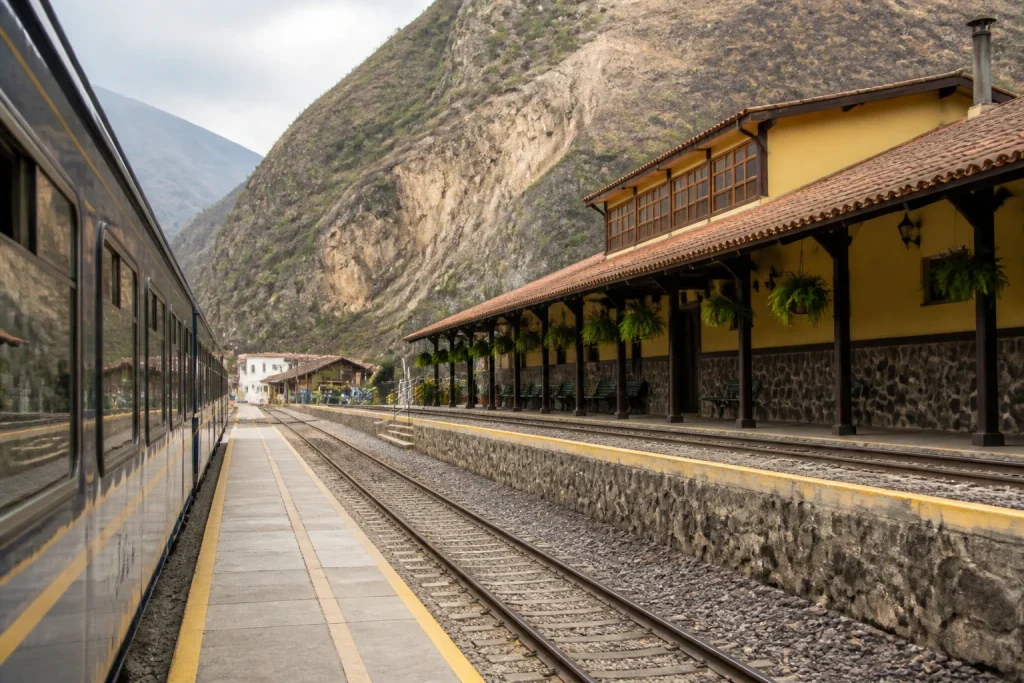
PeruRail lists Urubamba station at Av. Ferrocarril s/n and identifies Vistadome departures there. The station is in a different location from Ollantaytambo, so a ticket naming Urubamba should be followed literally. Do not arrange transport to Ollantaytambo simply because it is the better-known rail hub.
Urubamba works best for travelers staying nearby when the desired departure is actually offered there. If you are still choosing a base, our guide to Sacred Valley lodges, hotels, and villages can help compare locations. Make the lodging decision together with the rail schedule rather than assuming every valley hotel has equal access to every train.
How to approach a Pachar departure or transfer
Pachar is separately identified as a rail location and should be treated as a service-specific boarding or transfer point. Its role is especially important during the 2026 access works, when designated Ollantaytambo services can involve buses from Pachar. Follow the service number and meeting instructions rather than relying on general station advice.
If a booking names Pachar, arrange road transportation to that exact point and allow time for the handoff described by the operator. If the ticket names Ollantaytambo without a Pachar instruction, do not switch stations independently. Temporary changes are attached to particular services rather than every passenger using the corridor.
Cusco departures can involve a bimodal journey
A ticket sold as a Cusco-origin journey does not always mean boarding a train in central Cusco. Current operations can involve Wanchaq, Poroy, Pachar, and Ollantaytambo in different bus-and-train combinations. Describe the trip as a direct rail journey only when the booked itinerary explicitly shows that arrangement.
Read each leg in order. Identify the first meeting point, the transportation mode used on that leg, the transfer location, and the final rail departure. A Cusco meeting point can be convenient for a city-based traveler, but the bus-to-train handoff adds another timed connection and another piece of luggage handling.
The tradeoff is simple. A coordinated Cusco-origin itinerary reduces the need to arrange your own road trip to a valley station, while an Ollantaytambo departure generally reduces transfer exposure for someone already staying in the Sacred Valley. Choose according to your sleeping location and the complete sequence printed on the ticket.
If you are still selecting a rail company or service style, our comparison of PeruRail and Inca Rail trains to Machu Picchu can help frame that decision. Station instructions must still come from the exact itinerary purchased, since an operator comparison cannot replace service-specific boarding details.
The train arrives in Machu Picchu Pueblo, below the citadel
Machu Picchu trains finish in Machu Picchu Pueblo, also called Aguas Calientes. The railway does not deliver passengers to the archaeological park entrance. The onward tourist-bus journey covers about 10 kilometers and takes roughly 30 minutes, so it needs its own place in the schedule.
Think of the arrival as three connected appointments: the train into town, the bus boarding process, and the timed Machu Picchu entry. A delay or overly tight gap at the first stage can affect the rest of the sequence. Leave a realistic buffer instead of treating the train arrival and site entry as the same moment.
- Arrive in Machu Picchu Pueblo on the booked train.
- Complete the transfer required to reach the tourist-bus boarding point.
- Allow time for the approximately 30-minute road journey.
- Reach the archaeological park in time for the entry slot on your ticket.
Budget and ticket planning should also treat these elements separately. The rail fare, the bus between town and the citadel area, and the timed site-entry ticket are distinct parts of the journey. A rail reservation alone does not complete the access plan.
Still comparing Sacred Valley Train Stations?
Ask for tour ideas, hotel suggestions, or a simple trip plan that combines both.
Trip Helper
Build the itinerary around confirmed transfer points
A reliable itinerary begins with the fixed parts of the day and works outward. Keep every station name, mode change, and entry time in one sequence. This is more useful than looking at the train departure in isolation.

- Choose a Machu Picchu entry plan and note the timed admission.
- Select a rail itinerary that leaves room for the onward bus and entry process.
- Confirm the exact boarding station and check whether the first leg is by bus or train.
- Arrange transportation to the first meeting point named on the booking.
- Check for service-specific Pachar or Ollantaytambo access instructions.
- Leave breathing room before any flight, long-distance bus, or other tightly timed connection.
Keep the return journey under the same level of scrutiny. The outbound and return tickets can use different times, service patterns, or transfer arrangements. Read both directions independently instead of assuming the morning sequence will simply run in reverse.
The corridor can experience incident-related interruptions. Service affected by an incident on December 30, 2025, was reported fully restored on January 1, 2026, so that event does not represent a current closure. It does show why travelers should check service status near departure and avoid connecting the train to an unforgiving onward schedule.
Train costs depend on the complete route
There is no useful single price for using a Sacred Valley train station. Rail fares vary with the operator, service class, travel date, direction, and chosen station or transfer itinerary. Price the exact journey rather than comparing a generic figure that may describe a different departure point or service.
| Budget item | When it applies | What to check |
|---|---|---|
| Rail ticket | Every rail passenger | Operator, service, date, direction, boarding point, and transfer pattern. |
| Cusco-side road leg | When using a bimodal itinerary | Whether the road connection is included in the selected service. |
| Transport to a Sacred Valley station | When reaching Ollantaytambo, Urubamba, or Pachar independently | The precise station or meeting point named on the ticket. |
| Machu Picchu Pueblo tourist bus | For the road journey toward the archaeological park | Allow both budget and time for this separate leg. |
| Timed Machu Picchu entry | For admission to the archaeological site | Match the entry plan with the rail and bus schedule. |
Compare totals only after all required legs are visible. A seemingly convenient fare can produce extra costs if it requires an independent station transfer, while a bimodal booking can package part of that connection into the itinerary. The route details matter as much as the headline fare.
Accessibility and luggage needs require advance confirmation
Travelers who use wheelchairs, have limited mobility, carry bulky luggage, or need extra boarding time should contact the booked rail operator before purchase. Confirm vehicle access, platform conditions, boarding assistance, luggage handling, and every bus connection included in the itinerary. Do not assume that arrangements at one station also apply at another.
- Can the traveler reach and board the assigned train or bus safely?
- What assistance is available at each transfer point?
- What are the platform and vehicle access conditions?
- How will mobility equipment or bulky luggage be handled?
- Does the onward Machu Picchu Pueblo bus connection meet the traveler’s needs?
Extra time matters whenever boarding involves assistance or equipment. At Ollantaytambo, PeruRail tells passengers to board 30 minutes before departure, but individual needs can require a larger margin. Use the operator’s guidance to choose an appropriate arrival time for the traveler and the specific service.
Apply the same planning to a bimodal trip. Accessibility must work across the full chain, including the first road vehicle, the transfer point, the train, and the bus connection after arrival in Machu Picchu Pueblo. A suitable rail carriage does not solve an inaccessible handoff elsewhere in the journey.

Machu Picchu Circuit 2 + Bus to Entrance Combo
Explore the Inca ruins of Machu Picchu at your own pace and your own schedule. Avoid long lines at Machu Picchu by b...
Private Transfer from Valle Sagrado to Alejandro Velasco Astete (CUZ) Airport
Take the worry out of your departure to Alejandro Velasco Astete (CUZ) Airport and pre-book a private transfer to su...
Bus Ticket To Machu Picchu (Up & Down)
Book With Confidence Simple. Fast. Stress free. Once you book, we send your bus ticket directly to your email or Wh...
Choose the station that matches your base and ticket
- Staying in Ollantaytambo or elsewhere in the valley: check Ollantaytambo departures first.
- Staying near Urubamba: use Urubamba only when the preferred train explicitly serves it.
- Staying in Cusco: compare the convenience of a coordinated bimodal itinerary with traveling independently to the valley.
- Assigned to Pachar: follow the service-specific meeting and transfer instructions.
- Traveling with mobility or luggage concerns: confirm the whole transfer chain before buying.
Ollantaytambo is the most practical starting point for many Sacred Valley visitors, but the correct station is always the one named by the service you have chosen. Urubamba can be convenient for a nearby stay, Pachar can be essential to a specific transfer plan, and a Cusco departure can suit travelers who prefer a coordinated road-and-rail itinerary.

Once the boarding point is settled, connect the remaining pieces in order: station access, boarding time, any bus-to-train transfer, arrival in Machu Picchu Pueblo, the tourist bus, and timed site entry. That sequence turns a collection of tickets into a workable travel day.
Frequently asked questions
What is the best train station in the Sacred Valley for Machu Picchu?
Ollantaytambo is the principal practical choice for most travelers already staying in the Sacred Valley. PeruRail lists Expedition and Vistadome departures there, while Urubamba and Pachar apply to more specific services or transfer plans.
Are Ollantaytambo and Urubamba train stations the same place?
No, Ollantaytambo and Urubamba are separate stations in different locations. Follow the exact station printed on the rail ticket and arrange road transportation accordingly.
When should I use Pachar station?
Use Pachar when your booked itinerary specifically assigns it as a boarding or transfer point. During the 2026 Ollantaytambo access works, designated PeruRail services can include a bus transfer from Pachar.
Can I board a direct train in central Cusco?
A Cusco-origin booking can be a bimodal bus-and-train itinerary rather than a direct central-Cusco rail departure. Check every leg for the meeting point, transportation mode, and transfer location.
Does the train take passengers directly to Machu Picchu?
No, the train arrives in Machu Picchu Pueblo, also known as Aguas Calientes. The onward tourist-bus journey to the archaeological park covers about 10 kilometers and takes roughly 30 minutes.
How early should I arrive at Ollantaytambo station?
PeruRail instructs passengers at Ollantaytambo to board 30 minutes before departure. Arrive with enough additional time to reach the correct entrance, particularly while the 2026 road-access changes are in effect.
How long is the train from Ollantaytambo to Machu Picchu Pueblo?
Allow about 2 hours 10 minutes as a broad planning estimate. The booked timetable should control your plans because service patterns and operating conditions can affect the journey.
How much does the Sacred Valley train cost?
The fare depends on the operator, service class, date, direction, station, and transfer itinerary. Price the exact route and budget separately for any additional road transfer, the Machu Picchu Pueblo tourist bus, and timed site admission.
Are Sacred Valley train stations wheelchair accessible?
Accessibility should be confirmed with the booked rail operator before purchase. Ask about vehicle access, platforms, boarding help, mobility equipment, luggage handling, and all required bus transfers.
Machu Picchu by Train: A Once in a Lifetime Day Trip from Cusco
See Machu Picchu in a day without the stress of organizing it yourself. From your Cusco pickup to the train, shuttle bus, entrance, and expert guided...
Machu Picchu 2Day Tour by Train from Cusco with Overnight Stay
Our tour guides at Machu Picchu are incredibly passionate about storytelling and are committed to creating unforgett...

Machu Picchu Private Archaeological and Historical Guided Tour
Explore Machu Picchu, one of the Seven Wonders of the World, in the company of a private guide. Enjoy the undivided...
Private Transfer from Valle Sagrado to Alejandro Velasco Astete (CUZ) Airport
Take the worry out of your departure to Alejandro Velasco Astete (CUZ) Airport and pre-book a private transfer to su...
.JPG)