Sacred Valley Altitude Sickness Guide
The Sacred Valley is lower than Cusco, which makes it a sensible place to begin a highland itinerary. Still, the valley floor sits roughly 2,750 to 2,950 metres, or 9,020 to 9,680 feet, above sea level. That remains firmly high altitude. Unacclimatized travelers can face altitude-illness risk when sleeping at 2,450 metres, or 8,000 feet, and above. A valley stay reduces the elevation challenge; it does not remove it.
Sacred Valley altitude sickness: key takeaways
- The Sacred Valley is lower than Cusco, but its usual valley-floor elevations are still above the level where altitude illness can affect unacclimatized travelers.
- When practical, sleep in the valley instead of Cusco for your first one or two nights, then return to higher Cusco after that lower-elevation break.
- Keep the first 48 hours deliberately light. Avoid alcohol, strenuous hikes, via ferrata, and high passes while you assess how your body responds.
- Discuss acetazolamide or any altitude-related medication with a clinician before the trip. It is not a do-it-yourself decision.
- Build flexibility into transport and activities, and seek in-person medical assessment promptly if you suspect altitude illness.
Why the Sacred Valley can be a better first sleeping base than Cusco
Altitude risk is not an on-or-off switch. It rises with sleeping elevation, the speed of ascent, and individual susceptibility. The Sacred Valley’s lower floor gives many travelers a more gradual introduction than sleeping immediately in Cusco, which sits at about 3,400 metres, or 11,000 feet. The elevation difference is meaningful, yet the valley’s own altitude still calls for a measured first day and a conservative itinerary.

Machu Picchu Private Tour
Explore and experience Machu Picchu with professional tour guides and archaeologists. We will make sure you have a great tour in Machu Picchu. We are...

Machu Picchu Private Tour from Aguas Calientes (Tickets included)
Discover Machu Picchu at your own pace with our exclusive Private Guided Tour from Aguas Calientes. Perfect for inde...

Machu Picchu 2Day Tour by Train from Cusco with Overnight Stay
Our tour guides at Machu Picchu are incredibly passionate about storytelling and are committed to creating unforgett...

Machu Picchu Private Archaeological and Historical Guided Tour
Explore Machu Picchu, one of the Seven Wonders of the World, in the company of a private guide. Enjoy the undivided...
Use the lower-sleep principle, not a false sense of security
For travelers arriving in Cusco, a practical approach is to continue to a Sacred Valley hotel rather than make Cusco city the first overnight stop. CDC guidance notes that, in high-altitude destinations such as Cusco, descending to a lower elevation for one or two nights before going higher can help with acclimatization planning. A Sacred Valley stay applies that principle. It cannot guarantee that you will avoid altitude illness.
Plan the arrival day around rest and a post-flight transfer
Think of the Sacred Valley as a transfer after arriving in Cusco, not as an airport destination. Many travelers reach the region via a Lima-to-Cusco flight of roughly one hour, then continue by road. As a planning reference, Cusco to Ollantaytambo is about 90 kilometres and can take around two hours by private vehicle or 2.5 hours by bus. Road conditions, traffic, and service type affect the actual journey, so confirm current timing with your provider.

A simple low-stress arrival plan
- Arrange a transfer to a Sacred Valley base before travel, allowing for a slower pace after the flight.
- Keep the arrival afternoon free of demanding sightseeing, long climbs, and athletic activities.
- Eat, rest, and take only a gentle walk if you feel well enough, rather than trying to fit in a major archaeological site.
- Leave enough room in the schedule to adjust the next day if you do not feel ready for a higher or more strenuous outing.
Ollantaytambo is a common valley base for travelers continuing toward Machu Picchu, and its compact historic core can fit a gentler first-day rhythm. If you plan to stay there, an Ollantaytambo living Inca town guide can help shape an easy introduction without turning arrival day into a race. Before departure, check with your accommodation, transport provider, and relevant local authorities for current road, weather, and access conditions.
Treat the first 48 hours as acclimatization time
CDC advises travelers arriving above 8,000 feet to avoid alcohol and heavy exercise for at least the first 48 hours. That advice applies across the documented Sacred Valley floor. Give your body time before booking a high pass, a demanding trek, or a climbing activity. The best early itinerary is intentionally modest: a comfortable bed, flexible timing, and no pressure to match the pace of friends who are already acclimatized.
Save these activities for later in the stay
- Strenuous hikes and steep archaeological-site walks
- Via ferrata and other exertion-heavy climbing activities
- Day trips that climb to a substantially higher elevation
- Alcohol-centered evenings that compromise a restful first night
- Tightly timed excursions with no room to rest or change plans
Know the altitude illnesses and make a clear escalation plan
Altitude illness includes acute mountain sickness, high-altitude pulmonary edema, and high-altitude cerebral edema. These are distinct conditions, and a travel guide cannot safely diagnose or sort symptoms at the bedside. Do not treat worsening illness at altitude as an inconvenience to push through for a tour, train, or hotel booking. Pause onward high-altitude plans and obtain prompt in-person medical assessment when altitude illness is suspected.
Practical safety rule: tell your guide, driver, or accommodation team if someone becomes ill at altitude, and prioritize access to in-person medical care over the day’s itinerary.
Make the practical arrangements before you need them. Keep your accommodation details available, know how you will reach medical care from your overnight base, and avoid an itinerary that strands you far from assistance after a hard first day. Do not rely on online symptom checklists, other travelers’ experiences, or a hotel remedy as a substitute for clinical evaluation. Detailed diagnostic thresholds and treatment instructions require medical oversight.

From the Sacred Valley: Salt Mines & Moray - Private tour
As a company based in the Sacred Valley, we are true specialists in the region, enabling us to provide a more person...

Machu Picchu: Official Entrance Tickets
With this ticket you can visit the Inca city of Machu Picchu. The ticket allows you to visit most of the archaeologi...

Full Day Sacred Valley of the Incas Private Tour
REQUEST A FREE TRANSFER IN OR OUT WITH THE BOOK OF THIS TOUR Embark on an unforgettable adventure with our tour. Di...
Discuss medication and your itinerary with a clinician before departure
Acetazolamide can be prescribed as preventive medication for travelers at risk of altitude illness, particularly when an itinerary does not allow gradual ascent. It should be discussed with a clinician before the trip, rather than borrowed, bought casually, or started on another traveler’s advice. Your clinician can weigh your health history, allergies, other medicines, intended sleeping elevations, and how quickly you will move through the Andes.
Travelers who should seek specialist pre-trip advice
From the Sacred Valley Chinchero, Maras, Moray and Ollantaytambo
What makes our tour special is that we are based right here in Urubamba, the heart of the Sacred Valley. Being locals gives us a unique advantage –...
MachuPicchu Private Full Day Tour by Vistadome train from Cusco
Experience the awe-inspiring legacy of the Incas with our premier, Machu Picchu private Full-Day Tour. Travel in unr...
Machu Picchu Full-Day Tour by Train from Cusco
On this tour you will explore Machu Picchu while accompanied by an experienced and knowledgeable guide who will expl...
Machu Picchu Private Tour from Aguas Calientes with Ticket & Bus
Maximize your time at Machu Picchu with this private guided tour starting directly from Aguas Calientes. Skip the ha...
Consult a clinician familiar with high-altitude travel before booking if you have coronary artery disease, chronic pulmonary disease or preexisting hypoxemia, obstructive sleep apnea, or sickle-cell trait.



This conversation is especially important when the trip combines a short arrival window with high sleeping elevations and strenuous plans. Bring a clear outline of your route, including nights in the Sacred Valley, Cusco, and any higher outings. Ask how your personal medical history changes the plan, what care you should carry, and how altitude-related medical treatment or evacuation is handled by your travel insurance.
Choose lodging and activities with flexibility in mind
A lower sleeping elevation is only useful if the overnight plan is comfortable and practical for you. Consider location, transfer time, stairs, room access, and the ease of changing plans if you need rest. Avoid assuming that a Sacred Valley hotel or an archaeological site is step-free, wheelchair-ready, supplied with oxygen, or easy to evacuate from. A guide to where to stay in the Sacred Valley, including lodges, hotels and villages, is a useful starting point for comparing bases.

- Ask your hotel about room access, stairs, transport drop-off points, and its process for helping guests obtain medical care.
- Ask transport providers about vehicle access and whether they can adapt pickup timing for a slower arrival day.
- Ask archaeological-site operators about walking surfaces, steps, toilets, and the practical options for travelers with mobility, respiratory, or fatigue constraints.
- Get these details in writing before booking if accessibility or medical logistics are central to your trip.
Health considerations beyond altitude
For travel limited to Cusco, the Sacred Valley, and Machu Picchu, CDC reports no dengue risk and describes malaria risk as insignificant at these high-altitude destinations. That narrow guidance changes if your itinerary extends toward lower-elevation parts of the Cusco region or the Amazon. Yellow-fever vaccine recommendations can apply in some lower areas, including places below 2,300 metres, so review the full route with a travel-health clinician.
Budget for the lower-altitude strategy without relying on fixed prices
Sleeping in the Sacred Valley can add a road transfer and possibly an extra hotel night, but it gives you a lower first sleeping elevation than Cusco. Treat that as a health and comfort tradeoff rather than a guaranteed cure for altitude problems. Transfer, lodging, medical, and evacuation costs vary, so obtain current quotes and check whether your travel insurance covers altitude-related medical care and evacuation before committing to the itinerary.
Build a Sacred Valley itinerary that leaves room to adapt
Reserve demanding sightseeing for after your first two days, when possible. A flexible order of plans is more valuable than a packed checklist: begin with a valley hotel, keep the first day easy, then add walks, ruins, markets, and longer outings once you are feeling well. Use a guide to the best things to do in the Sacred Valley to arrange your priorities by effort and location, rather than forcing every highlight into the arrival window.
The Sacred Valley suits travelers who want a gentler start to Peru’s highlands without sacrificing the landscapes and historic places that make the region memorable. Sleep lower than Cusco when the itinerary allows, move deliberately for the first 48 hours, and make medical planning part of the trip rather than an afterthought. That combination gives you the best chance to enjoy the stone streets, mountain views, and onward journey with better margins for comfort and safety.
Frequently asked questions
Can you get altitude sickness in the Sacred Valley?
Yes. The Sacred Valley floor is roughly 2,750 to 2,950 metres, which is high enough for altitude illness to affect unacclimatized travelers. It is lower than Cusco, but it does not eliminate risk.
Is it better to stay in the Sacred Valley before sleeping in Cusco?
For many itineraries, yes. Sleeping in the lower Sacred Valley for one or two nights before returning to Cusco follows CDC guidance about using a lower elevation to sleep when visiting very high destinations. It is a risk-reduction strategy, not a medical guarantee.
What should I avoid during my first 48 hours in the Sacred Valley?
Avoid alcohol and heavy exercise for at least the first 48 hours after arriving at this elevation. Save strenuous hikes, climbing activities, and higher outings until you have had time to acclimatize.
Should I take acetazolamide for the Sacred Valley?
Discuss acetazolamide with a clinician before travel if you are considering it. CDC identifies it as a prescription preventive option for travelers at risk, especially when gradual ascent is not practical.
Who should get medical advice before visiting the Sacred Valley?
Travelers with coronary artery disease, chronic pulmonary disease or preexisting hypoxemia, obstructive sleep apnea, or sickle-cell trait should consult a clinician familiar with high-altitude travel before departure.
Do I need to worry about dengue or malaria in the Sacred Valley?
For travel limited to Cusco, the Sacred Valley, and Machu Picchu, CDC reports no dengue risk and considers malaria risk insignificant. Health recommendations change for lower-elevation destinations and Amazon travel.
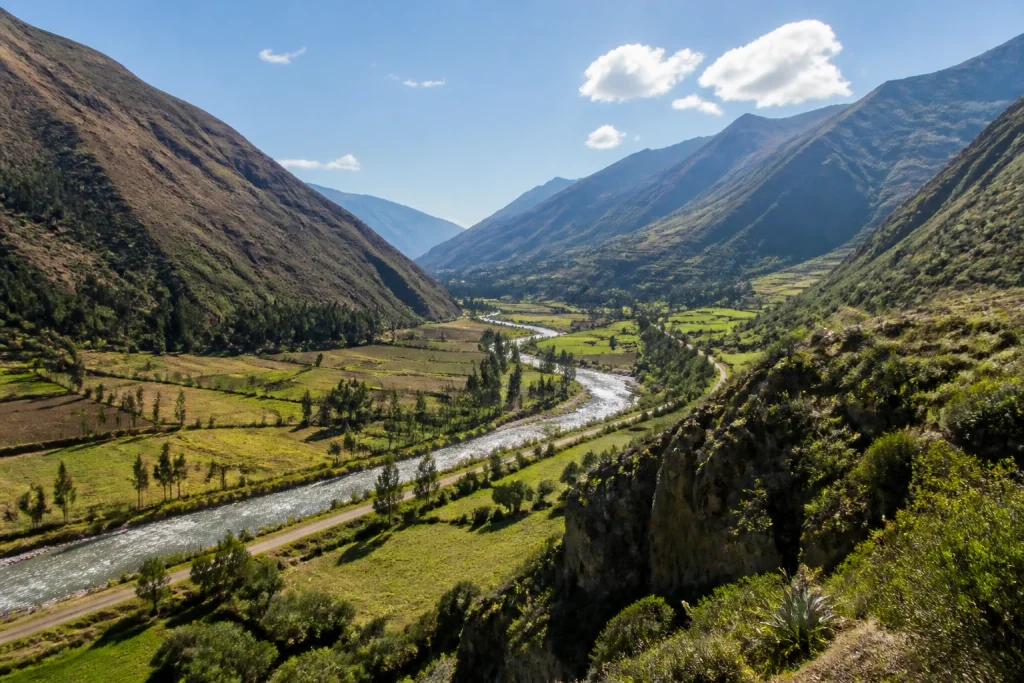
A wide view across Peru’s Sacred Valley by Aufgang, CC BY-SA 3.0.


